Saturday, September 11, 2010

Failing To Convince, Climate Activists Threaten Instead

In what can only be seen as that latest tactic by Greenpeace in their evangelical approach to Climate change is to directly threaten those members of the wider public who have not been convinced by their arguments, hectoring and abuse of the past. In an article by Paul Joseph Watson entitled: Greenpeace To Global Warming Skeptics: “We Know Where You Live” we find the following:

An article carried by the official Greenpeace website written by a Greenpeace member urges climate activists to resort to criminal activity in an effort to reinvigorate momentum for their stalling global warming agenda, while ominously threatening climate skeptics, “we know where you live”.

The article, written by Greenpeace activist “Gene” from India, calls for “mass civil disobedience to cut off the financial oxygen from denial and skepticism”.

“Gene” then has a special message for roughly half of Americans who, in the wake of the climategate scandal, are now skeptical of man-made global warming – “We know who you are. We know where you live. We know where you work. And we be many, but you be few.”

“Gene” quotes another climate activist who calls for an army of greenies to break the law and take retribution against anyone who stands in their way.

“The politicians have failed. Now it’s up to us. We must break the law to make the laws we need: laws that are supposed to protect society, and protect our future. Until our laws do that, screw being climate lobbyists. Screw being climate activists. It’s not working. We need an army of climate outlaws.”

Greenpeace has not issued a retraction of the comments, preferring instead to buffer the blog at both beginning and end with desperate-sounding explanations insisting that the author has peaceful intentions. The organization has obviously been taking a hammering for this as it worsens into another public relations disaster.

This is by no means the first time global warming adherents have resorted to physical threats in an effort to bolster their rapidly crumbling credibility on climate change issues. In June last year, a global warming activist posted an article on the Talking Points Memo website entitled “At What Point Do We Jail Or Execute Global Warming Deniers?”

Shortly after the article was retracted, a comment traced back to another prominent global warming activist which appeared on the Climate Progress blog threatened Skeptics that “an entire generation that will soon be ready to strangle you and your kind while you sleep in your beds.” Website owner Joe Romm defended the comment as “clearly not a threat but a prediction”.

For years, climate Skeptics have been the target of campaigns to denounce them as criminals and traitors on the scale of the Nazis, with calls for Nuremberg trials. A July 2007 Senate report detailed how skeptical scientists have faced threats and intimidation.

“Is this really the kind of caring, sensitive message this charity ought to be conveying to the world?” asks James Delingpole. “Not to judge by the comments below. Happy Easter, Greenpeace PR department! I think you’re going to have a busy next few days…”

As a recent Psychological Science study highlighted, warmists tend not to adhere to the caring, sensitive image they portray when it comes to their own private lives.

“Those who wear what the authors call the “halo of green consumerism” are less likely to be kind to others, and more likely to cheat and steal,” summarizes the Telegraph’s Iain Hollingshead. “Faced with various moral choices – whether to stick to the rules in games, for example, or to pay themselves an appropriate wage – the green participants behaved much worse in the experiments than their conventional counterparts. The short answer to the paper’s question, then, is: No. Greens are mean.”

Despite Greenpeace’s efforts at damage control, there can be little doubt as to the true context of the article. By first encouraging climate activists to “break the law” in pursuit of their stalling political agenda, “Gene” has greased the skids for criminal activity. Concluding with the threat to climate Skeptics that “we know where you live,” is clearly a form of intimidation and an invitation for “an army of climate outlaws” to take physical retribution against people who disagree with them.

Imagine if Infowars put out an article urging its readers to break the law in order to combat the IRS, imagine if we told IRS agents, “we know where you live”. We’d be raided quicker than a heartbeat and Alex Jones would be demonized all over the establishment media as a dangerous extremist. Indeed, a mere peaceful letter-writing campaign urging governors to resign was leapt upon by the media and the federal government this past weekend as a concerning portend of the “extremist” threat posed by constitutionalists despite the fact that there was no indication of violence.

When so-called “right-wingers” or libertarians merely write letters urging peaceful political change, they are demonized as terrorist hate-mongers, but when greenies openly call for criminal behavior allied with thinly veiled threats of physical violence, it’s no big deal.

Will CNN and MSNBC devote weeks of endless coverage to Greenpeace’s threats towards people they disagree with? There’s more chance of Keith Olbermann awarding Rep. Hank Johnson (a major global warming adherent) his “worst person in the world” gong for hilariously warning that the island of Guam could capsize like a boat due to overpopulation.

Another example is this recent video from Greenpeace of a hooded youth who has clearly been so wound up with their hype that he snarls his way through his presentation and log of climate claims that adults are killing his world:

“By the time I grow up there won’t be any fish left in the sea,” he snarls at the camera.

“Clean air will be a thing of the past, polar ice caps will be gone, oceans will rise, entire countries will disappear ... There could be famine, worldwide epidemics ...

“We’re not just talking about the future, we’re talking about my future.”

Believe all that and you’re excused the threat this boy makes next: “Starting today, the lines are drawn. You have to choose sides. You can be for my future or you’re against it. You’re a friend, or you’re an enemy.

“I may be just a kid a today, but tomorrow will be different ...

“You’ve had your chance to fix this problem. Now we have ours. We won’t be cute. We won’t be patronised. We won’t be denied our future.”

Once again we see an organisation with the word "peace" in it's title has becom so totalitarian and militant in it's beliefs that it is now prepared to enlist child soldiers to its ranks to fight it's climate war against the very populace from which it rose. But again this is not surprising given their total hatred and contempt for the human race that they advocate such extreme measures as:

“All programs on Discovery Health-TLC must stop encouraging the birth of any more parasitic human infants ... In those programs’ places, programs encouraging human sterilisation and infertility must be pushed ..

...“For every human born, ACRES of wildlife forests must be turned into farmland in order to feed that new addition over the course of 60 to 100 YEARS of that new human’s lifespan! THIS IS AT THE EXPENSE OF THE FOREST CREATURES!!!!”

Demanded James J. Lee who burst into Discovery Channel’s Maryland headquarters to demand the station do more to save the planet from the Armageddon we’re told will be caused by global warming and held three hostages at gunpoint until police shot him dead, thus reducing his population.

put something in the water, a virus that would be specific to the human reproductive system, and would make a substantial proportion of the population infertile”.

Suggested Dr John Reid, a former Swinburne University academic, in a lecture on the (Australian) ABC’s Ockham’s Razor program with fellow warmist Robyn Williams. Needless to say this wasn't challenged in any way.

Adding a sterilant to drinking water or staple foods is a suggestion that seems to horrify people more than most proposals for involuntary fertility control,”...

...“A program of sterilising women after their second or third child” and “the development of a long-term sterilising capsule that could be implanted under the skin and removed when pregnancy is desired”, which “opens additional possibilities for coercive fertility control”.

Were the ideas though about by President Obama's chief science adviser, John Holdren, when he co-wrote his 1977 book, Ecoscience.

Whilst none of those mentioned above were or are members of Greenpeace, Paul Watson who was a co founder of Greenpeace and is the current Captain of the Sea Shepard anti whaling ship is and he says the following about the human race:

“We need to radically and intelligently REDUCE HUMAN POPULATIONS to fewer than one billion” because humans are “the AIDS of the Earth” and “our viral like behaviour can be TERMINAL both to the present biosphere and ourselves”.

It seems it is a common attitude towards humanity from those that see themselves as the ultimate warriors for the environment, that they want "your" "population reduced" by any means fair or foul.

Friday, September 10, 2010

IPCC Continues To Fail In Its Bid For Accuracy

At the start of September 2010 yet another blunder was discovered about the IPCC's 4th Assessment Report. This blunder involved Plagiarism of a book written in 1993 titled Planetary Overload: Global Environmental Change and the Health of the Human Species. The book was authored by an Australian epidemiology professor named Anthony McMichael.


Professor McMichael is a known believer in AGW and is not above releasing alarmist statements to support his beliefs(my emphasis added): "As climate change advances we must realise that it endangers more than the economy, infrastructure and valued species. Climate change, ominously, is disrupting and weakening Earth's life-supporting capacity. This poses a profound, and growing, risk to human wellbeing, health and survival."

In her post The Book the IPCC Plagiarized author Donna Laframboise examines this closely:

Some people think early editions of the Intergovernmental Panel on Climate Change (IPCC) report were scrupulously science-based, but that the process became more politicized in recent years. A look at the first appearance of the health chapter – in the 1995 edition – challenges this view. [29-page PDF of the chapter]

The person who headed that effort was an Australian epidemiology professor named Anthony McMichael. According to a 2001 bio, his early research interests included mental health, occupational diseases, the link between diet and cancer, and environmental epidemiology (diseases). In the late 1980s he co-authored a “bestselling guide to a healthier lifestyle” that discussed nutrition and physical fitness.

The bio tells us it was only “during the 1990s” that McMichael developed “a strong interest” in the risks associated with global environmental change. So in the early 1990s, out of all the experts in the entire world the IPCC might have chosen to oversee the writing of a section dealing with climate change and human health, why was McMichael selected?

Stacking the Deck I suspect it had a great deal to do with another book he wrote – the one that appeared in 1993 titled Planetary Overload: Global Environmental Change and the Health of the Human Species. This book’s central theme is that human activity is undermining the planet’s ecosystem. Its tone, language, and analysis are similar to hundreds of other environmental treatises published in recent decades.

McMichael declares that “humans cannot live apart from nature, remote from the great web of life.” He frets that we are too distant “from the rhythms of natural systems.” He speaks of environmental degradation as “an unprecedented moral problem” and says people in rich countries live a wasteful, “ecologically distorted lifestyle.”

His language is not the tentative sort used by dispassionate scientists. Back in 1993 he didn’t say there was concern that carbon dioxide might eventually “disrupt various of the biosphere’s natural cycles,” he confidently proclaimed that it would. Like a long line of other eco thinkers, he believes environmental challenges require a wholesale “reordering of social values.”

McMichael’s Planetary Overload arguments rely on a Greenpeace report about global warming. His book frequently cites articles in non-peer-reviewed publications such as New Scientist and Scientific American. McMichael is, in other words, an environmentalist whose day job happens to involve the study of public health. He has no expertise in most of the topics his book discusses.

He is, of course, entitled to his personal opinions. But was he the best choice to lead an IPCC chapter? Let’s rephrase that: if one wished to deliberately stack the deck, to ensure that a certain perspective would dominate the climate bible’s first health chapter, would someone who had expressed views similar to McMichael’s not have seemed like the perfect candidate?

There is a straight line between what the UN’s 1995 climate bible told the world about health issues and what McMichael had already written in his 1993 book. Although Planetary Overload isn’t included among the 182 references listed at the end of the health chapter, entire passages of the climate bible were lifted directly from it. A selection appears below:

McMichael’s 1993 book, page 150:
Sandstorms in Kansas (USA) and in the Sudan have been accompanied by increased illness and death from bronchitis and asthma.

Climate Bible’s 1995 Working Group 2 report, page 578:
Sandstorms in Kansas (USA) and the Sudan have been accompanied by increases in bronchitis and asthma.

McMichael’s 1993 book, page 155:
In Egypt, for example, the water snails tend to lose their schistosome infections during the winter months (January-March). However, if temperatures increase, snails may spread schistosomiasis throughout the year, thus increasing the already heavy parasite burden in rural Egypt.

Climate Bible’s 1995 Working Group 2 report, page 574:
In Egypt, for example, water snails tend to lose their schistosome infections during winter, but if temperatures increase, snails may mediate schistosomiasis transmission throughout the year.

McMichael’s 1993 book, page 155:
Arboviral infections span a wide clinical spectrum, from those that cause mild feverish illness or subclinical infections to those causing severe and often fatal encephalitis (brain inflammation) or hemorrhagic fever. Under favourable environmental conditions, an arboviral disease can become epidemic (population-wide), from a local endemic base – in much the same way that cholera has recently broken out…

Climate Bible’s 1995 Working Group 2 report, page 575:
Arboviral infections span a wide clinical spectrum, from those that cause mild feverish illness or subclinical inflections to those causing severe and often fatal encephalitis (brain inflammation) or hemorrhagic fever. Under favorable environmental conditions, an arboviral disease can become epidemic (population-wide), from a local endemic base or by its introduction to a previously unaffected area.

McMichael’s 1993 book, page 154:
In eastern Africa, a relatively small increase in winter temperature would enable the malarial zone to extend ‘upwards’ to engulf the large urban highland populations that are currently off-limits to the mosquito because of the cooler temperatures at higher altitudes – e.g. Nairobi (Kenya) and Harare (Zimbabwe). Indeed, such populations around the world, currently just outside the margins of endemic malaria, would provide early evidence of climate-related shifts in the distribution of this disease.

Climate Bible’s 1995 Working Group 2 report, page 574:
Hence, it is a reasonable prediction that, in eastern Africa, a relatively small increase in winter temperature could extend the mosquito habitat and thus enable faciparum malaria to reach beyond the usual altitude limit of around 2,500 m to the large, malaria-free, urban highland populations, e.g. Nairobi in Kenya and Harare in Zimbabwe. Indeed, the monitoring of such populations around the world, currently just beyond the boundaries of stable endemic malaria, could provide early evidence of climate-related shifts in malaria distribution.

McMichael’s 1993 book, page 165:
Already in Africa, there are over 100 million people who are ‘food insecure’, many of them in the arid Sahel region, home to approximately 35 million people.

Climate Bible’s 1995 Working Group 2 report, page 577:
Already in Africa, more than 100 million people are “food insecure,” many of them in the arid Sahel region.

McMichael’s 1993 book, page 166:
A rise in temperature could also have significant effects on the growth and health of farm animals. Young animals are less tolerant of a wide range of temperature than are adult animals.

Climate Bible’s 1995 Working Group 2 report, page 577:
An increase in temperature and temperature extremes could also affect the growth and health of farm animals; young animals are much less tolerant of temperature variation than are adult animals.

McMichael’s 1993 book, page 166:
With respect to adverse effects on livestock, the U.S. Environmental Protection Agency has identified several infectious diseases – such as the horn fly in beef and dairy cattle and insect-borne anaplasmosis infection in sheep and cattle – which might well increase in response to climate changes.

Climate Bible’s 1995 Working Group 2 report, page 577:
For example, the U.S. Environmental Protection Agency has identified several infectious diseases – such as the horn fly in beef and dairy cattle and insect-borne anaplasmosis infection in sheep and cattle – that could increase in prevalence in response to climate changes.

McMichael’s 1993 book, page 187:
UNEP predicts that an average 10% loss of ozone (such has become established at middle-to-high latitudes in recent years), if sustained globally over three-four decades, would cause at least 300,000 additional cases of non-melanocytic skin cancer worldwide each year and 4,500 extra cases of malignant melanoma – and possibly double that figure.

Climate Bible’s 1995 Working Group 2 report, page 578:
The UN environment Programme predicts that an average 10% loss of ozone (such as occurred at middle-to-high latitudes over the past decade), if sustained globally over several decades, would cause approximately 250,000 additional cases of [nonmelanocytic skin cancers] worldwide each year.

It appears unlikely that a good faith, bona fide review of the scientific literature took place prior to the writing of significant sections of the IPCC’s first health chapter. Instead, the climate bible surreptitiously incorporated numerous opinions expressed a few years earlier by the activist-oriented person in charge of writing this chapter.

Then the media told the world that the IPCC’s proclamations regarding global warming and diseases such as malaria were the considered, consensus view of thousands of experts.

Then the following day we find out via Dr. Jo Nova that Dr. Pachauri admits the IPCC just guesses the numbers. She writes:

Such is the pressure finally beginning to bear on the IPCC that Pachauri has been forced into the ridiculous position of trying to rescue credibility by contradicting most of their past PR campaign. He’s taken the extraordinary step of admitting they don’t have hard numbers, hey, but it’s all OK because the IPCC is really a government agency to make policy, not to write scientific reports “that don’t see the light of day”.

So he’s admitting that the IPCC was all about policy prescriptions all along? And the science was just fudged-up window dressing to provide an excuse? Well, who would have guessed.

Hidden beside Pachauri’s declaration that he’s happy about the IAC report, he let slip a corker of a line:

Times of India asks: Anything in the UN probe report you completely or partly disagree with?

They have talked about quantifying uncertainties. To some extent, we are doing that, though not perfectly. But the issue is that in some cases, you really don’t have a quantitative base by which you can attach a probability or a level of uncertainty that defines things in quantitative terms. And there, let’s not take away the importance of expert judgment. And that is something the report has missed or at least not pointed out.

So if you can’t quantify uncertainties (like is climate sensitivity say 0.5 degrees or 6.5 degrees, and with what probabilities) just go with your best guess, call it expert opinion (especially if you only pick and pay the “right” experts) and say that there is a 90% certainty, even if there are no numbers you can add up to get that.

Then after all these years of saying the IPCC is a scientific body, now that they’re exposed as being unscientific, suddenly the excuse is that really they’re policy driven. Watch how far away from science Pachauri is trying to position the IPCC:

Times of India: Stifling politics out of science, does that make it devoid of its real social purpose?

Let’s face it, we are an intergovernmental body and our strength and acceptability of what we produce is largely because we are owned by governments.
(And here was me thinking their strength was their “2500 scientists” and their rigorous review?)

If that was not the case, then we would be like any other scientific body that maybe producing first-rate reports but don’t see the light of the day because they don’t matter in policy-making. Now clearly, if it’s an inter-governmental body and we want governments’ ownership of what we produce, obviously they will give us guidance of what direction to follow, what are the questions they want answered. Unfortunately, people have completely missed the original resolution by which IPCC was set up. It clearly says that our assessment should include realistic response strategies. If that is not an assessment of policies, then what does it represent? And I am afraid, we have been, in my view, defensive in coming out with a whole range of policies and I am not saying we prescribe policy A or B or C but on the basis of science, we are looking at realistic response strategies.

But that is exactly what this committee has recommended that we get out of — policy prescriptions. It is for this reason that I brought out that this what is written in the IPCC mandate. This is a misperception on the part of some people in the scientific community. And I hope I can correct it.

The IPCC can’t be both the last word on impartially declaring the science AND the last word declaring the policy. Either the search for truth runs this agency or the need to push policy does, they can’t answer to both without a conflict.

He’s declaring that their first priority is NOT to figure out exactly what drives our climate.

Sunday, August 15, 2010

"Even if we have to redefine what the peer-reviewed literature is".

The title of this piece refers to a quote in one of the Climategate emails by Professor Phil Jones, when discussing papers by Steve McIntyre and Dr. Ross McKitrick as well as another by Dr. Chris De Freitas. Now that there have been three enquiries to whitewash away any damage done by these emails to the reputations of the CRU and Professor Jones we find the same thing happening again. Dr. Ross McKitrick writes on his blog:

SURFACE TEMPERATURES: In 2007 I published a paper with Pat Michaels showing evidence that CRU global surface temperature data used by the IPCC are likely contaminated due to socioeconomic development and variations in data quality. In 2008 Gavin Schmidt published a paper in the International Journal of Climatology claiming our results, as well as those of de Laat and Maurellis who independently found the same things we did, were spurious. My rebuttal, coauthored with Nicolas Nierenberg, was submitted to the IJOC in April 2009. We found out in February that it has been rejected. Interestingly, it turns out that the IJOC had sent Schmidt's paper, which focuses on defending Phil Jones' CRU data against its various critics, to be reviewed by none other than Phil Jones of the CRU. As you can imagine the review was rather enthusiastic and uncritical. The IJOC didn't ask deLaat or me to supply a review, nor did they invite us to contribute a response. And they have rejected the response we did submit, on the basis of some loopy referee reports to which Nico and I were not given a chance to reply (though we did anyway). Nice way they run a journal over at IJOC. The paper is being upgraded and submitted elsewhere. UPDATE: June 2010. The paper's been accepted subject to revisions. Details to come.

So sadly the saga and the manipulation by the alarmists continues.

Saturday, July 24, 2010

Dr. Roy Spencer's Global Warming For Dummies

In the recent tradition of (Insert subject here) for Dummies instruction booklets that have become all the rage Dr. Roy Spencer of the University of Alabama (Huntsville) has written an informative and easy to read laypersons booklet on Global Warming. Naturally in the tradition he called it My Global Warming Skepticism, for Dummies.

I receive many e-mails, and a recurring complaint is that many of my posts are too technical to understand. This morning’s installment arrived with the subject line, “Please Talk to Us”, and suggested I provide short, concise, easily understood summaries and explanations “for dummies”.

So, here’s a list of basic climate change questions, and brief answers based upon what I know today. I might update them as I receive suggestions and comments. I will also be adding links to other sources, and some visual aids, as appropriate.

Deja vu tells me I might have done this once before, but I’m too lazy to go back and see. So, I’ll start over from scratch.

It is important to understand at the outset that those of us who are skeptical of mankind’s influence on climate have a wide variety of views on the subject, and we can’t all be right. In fact, in this business, it is really easy to be wrong. It seems like everyone has a theory of what causes climate change. But it only takes one of us to be right for the IPCC’s anthropogenic global warming (AGW) house of cards to collapse.

As I like to say, taking measurements of the climate system is much easier than figuring out what those measurements mean in terms of cause and effect. Generally speaking, it’s not the warming that is in dispute…it’s the cause of the warming.

If you disagree with my views on something, please don’t flame me. Chances are, I’ve already heard your point of view; very seldom am I provided with new evidence I haven’t already taken into account.

1) Are Global Temperatures Rising Now?

There is no way to know, because natural year-to-year variability in global temperature is so large, with warming and cooling occurring all the time. What we can say is that surface and lower atmospheric temperature have risen in the last 30 to 50 years, with most of that warming in the Northern Hemisphere. Also, the magnitude of recent warming is somewhat uncertain, due to problems in making long-term temperature measurements with thermometers without those measurements being corrupted by a variety of non-climate effects. But there is no way to know if temperatures are continuing to rise now…we only see warming (or cooling) in the rearview mirror, when we look back in time.

2) Why Do Some Scientists Say It’s Cooling, while Others Say that Warming is Even Accelerating?

Since there is so much year-to-year (and even decade-to-decade) variability in global average temperatures, whether it has warmed or cooled depends upon how far back you look in time. For instance, over the last 100 years, there was an overall warming which was stronger toward the end of the 20th Century. This is why some say “warming is accelerating”. But if we look at a shorter, more recent period of time, say since the record warm year of 1998, one could say that it has cooled in the last 10-12 years. But, as I mentioned above, neither of these can tell us anything about whether warming is happening “now”, or will happen in the future.

3) Haven’t Global Temperatures Risen Before?

Yes. In the longer term, say hundreds to thousands of years, there is considerable indirect, proxy evidence (not from thermometers) of both warming and cooling. Since humankind can’t be responsible for these early events, this is evidence that nature can cause warming and cooling. If that is the case, it then opens up the possibility that some (or most) of the warming in the last 50 years has been natural, too. While many geologists like to point to much larger temperature changes are believed to have occurred over millions of years, I am unconvinced that this tells us anything of use for understanding how humans might influence climate on time scales of 10 to 100 years.

4) But Didn’t the “Hockey Stick” Show Recent Warming to be Unprecedented?

The “hockey Stick” reconstructions of temperature variations over the last 1 to 2 thousand years have been a huge source of controversy. The hockey stick was previously used by the IPCC as a veritable poster child for anthropogenic warming, since it seemed to indicate there have been no substantial temperature changes over the last 1,000 to 2,000 years until humans got involved in the 20th Century. The various versions of the hockey stick were based upon limited amounts of temperature proxy evidence — primarily tree rings — and involved questionable statistical methods. In contrast, I think the bulk of the proxy evidence supports the view that it was at least as warm during the Medieval Warm Period, around 1000 AD. The very fact that recent tree ring data erroneously suggests cooling in the last 50 years, when in fact there has been warming, should be a warning flag about using tree ring data for figuring out how warm it was 1,000 years ago. But without actual thermometer data, we will never know for sure.

5) Isn’t the Melting of Arctic Sea Ice Evidence of Warming?

Warming, yes…manmade warming, no. Arctic sea ice naturally melts back every summer, but that meltback was observed to reach a peak in 2007. But we have relatively accurate, satellite-based measurements of Arctic (and Antarctic) sea ice only since 1979. It is entirely possible that late summer Arctic Sea ice cover was just as low in the 1920s or 1930s, a period when Arctic thermometer data suggests it was just as warm. Unfortunately, there is no way to know, because we did not have satellites back then. Interestingly, Antarctic sea ice has been growing nearly as fast as Arctic ice has been melting over the last 30+ years.

6) What about rising sea levels?

I must confess, I don’t pay much attention to the sea level issue. I will say that, to the extent that warming occurs, sea levels can be expected to also rise to some extent. The rise is partly due to thermal expansion of the water, and partly due to melting or shedding of land-locked ice (the Greenland and Antarctic ice sheets, and glaciers). But this says nothing about whether or not humans are the cause of that warming. Since there is evidence that glacier retreat and sea level rise started well before humans can be blamed, causation is — once again — a major source of uncertainty.

7) Is Increasing CO2 Even Capable of Causing Warming?

There are some very intelligent people out there who claim that adding more carbon dioxide to the atmosphere can’t cause warming anyway. They claim things like, “the atmospheric CO2 absorption bands are already saturated”, or something else very technical. [And for those more technically-minded persons, yes, I agree that the effective radiating temperature of the Earth in the infrared is determined by how much sunlight is absorbed by the Earth. But that doesn't mean the lower atmosphere cannot warm from adding more greenhouse gases, because at the same time they also cool the upper atmosphere]. While it is true that most of the CO2-caused warming in the atmosphere was there before humans ever started burning coal and driving SUVs, this is all taken into account by computerized climate models that predict global warming. Adding more “should” cause warming, with the magnitude of that warming being the real question. But I’m still open to the possibility that a major error has been made on this fundamental point. Stranger things have happened in science before.

8 ) Is Atmospheric CO2 Increasing?

Yes, and most strongly in the last 50 years…which is why “most” climate researchers think the CO2 rise is the cause of the warming. Our site measurements of CO2 increase from around the world are possibly the most accurate long-term, climate-related, measurements in existence.

9) Are Humans Responsible for the CO2 Rise?

While there are short-term (year-to-year) fluctuations in the atmospheric CO2 concentration due to natural causes, especially El Nino and La Nina, I currently believe that most of the long-term increase is probably due to our use of fossil fuels. But from what I can tell, the supposed “proof” of humans being the source of increasing CO2 — a change in the atmospheric concentration of the carbon isotope C13 — would also be consistent with a natural, biological source. The current atmospheric CO2 level is about 390 parts per million by volume, up from a pre-industrial level estimated to be around 270 ppm…maybe less. CO2 levels can be much higher in cities, and in buildings with people in them.

10) But Aren’t Natural CO2 Emissions About 20 Times the Human Emissions?

Yes, but nature is believed to absorb CO2 at about the same rate it is produced. You can think of the reservoir of atmospheric CO2 as being like a giant container of water, with nature pumping in a steady stream into the bottom of the container (atmosphere) in some places, sucking out about the same amount in other places, and then humans causing a steady drip-drip-drip into the container. Significantly, about 50% of what we produce is sucked out of the atmosphere by nature, mostly through photosynthesis. Nature loves the stuff. CO2 is the elixir of life on Earth. Imagine the howls of protest there would be if we were destroying atmospheric CO2, rather than creating more of it.

11) Is Rising CO2 the Cause of Recent Warming?

While this is theoretically possible, I think it is more likely that the warming is mostly natural. At the very least, we have no way of determining what proportion is natural versus human-caused.

12) Why Do Most Scientists Believe CO2 is Responsible for the Warming?

Because (as they have told me) they can’t think of anything else that might have caused it. Significantly, it’s not that there is evidence nature can’t be the cause, but a lack of sufficiently accurate measurements to determine if nature is the cause. This is a hugely important distinction, and one the public and policymakers have been misled on by the IPCC.

13) If Not Humans, What could Have Caused Recent Warming?

This is one of my areas of research. I believe that natural changes in the amount of sunlight being absorbed by the Earth — due to natural changes in cloud cover — are responsible for most of the warming. Whether that is the specific mechanism or not, I advance the minority view that the climate system can change all by itself. Climate change does not require an “external” source of forcing, such as a change in the sun.

14) So, What Could Cause Natural Cloud Changes? I think small, long-term changes in atmospheric and oceanic flow patterns can cause ~1% changes in how much sunlight is let in by clouds to warm the Earth. This is all that is required to cause global warming or cooling. Unfortunately, we do not have sufficiently accurate cloud measurements to determine whether this is the primary cause of warming in the last 30 to 50 years.

15) How Significant is the Climategate Release of E-Mails?

While Climategate does not, by itself, invalidate the IPCC’s case that global warming has happened, or that humans are the primary cause of that warming, it DOES illustrate something I emphasized in my first book, “Climate Confusion”: climate researchers are human, and prone to bias.

16) Why Would Bias in Climate Research be Important? I thought Scientists Just Follow the Data Where It Leads Them

When researchers approach a problem, their pre-conceived notions often guide them. It’s not that the IPCC’s claim that humans cause global warming is somehow untenable or impossible, it’s that political and financial pressures have resulted in the IPCC almost totally ignoring alternative explanations for that warming.

17) How Important Is “Scientific Consensus” in Climate Research?

In the case of global warming, it is nearly worthless. The climate system is so complex that the vast majority of climate scientists — usually experts in variety of specialized fields — assume there are more knowledgeable scientists, and they are just supporting the opinions of their colleagues. And among that small group of most knowledgeable experts, there is a considerable element of groupthink, herd mentality, peer pressure, political pressure, support of certain energy policies, and desire to Save the Earth — whether it needs to be saved or not.

18) How Important are Computerized Climate Models?

I consider climate models as being our best way of exploring cause and effect in the climate system. It is really easy to be wrong in this business, and unless you can demonstrate causation with numbers in equations, you are stuck with scientists trying to persuade one another by waving their hands. Unfortunately, there is no guarantee that climate models will ever produce a useful prediction of the future. Nevertheless, we must use them, and we learn a lot from them. My biggest concern is that models have been used almost exclusively for supporting the claim that humans cause global warming, rather than for exploring alternative hypotheses — e.g. natural climate variations — as possible causes of that warming.

19) What Do I Predict for Global Temperature Changes in the Future?

I tend to shy away from long-term predictions, because there are still so many uncertainties. When pressed, though, I tend to say that I think cooling in our future is just as real a possibility as warming. Of course, a third possibility is relatively steady temperatures, without significant long-term warming or cooling. Keep in mind that, while you will find out tomorrow whether your favorite weather forecaster is right or wrong, no one will remember 50 years from now a scientist today wrongly predicting we will all die from heat stroke by 2060.

Concluding Remarks

Climate researchers do not know nearly as much about the causes of climate change as they profess. We have a pretty good understanding of how the climate system works on average…but the reasons for small, long-term changes in climate system are still extremely uncertain.

The total amount of CO2 humans have added to the atmosphere in the last 100 years has upset the radiative energy budget of the Earth by only 1%. How the climate system responds to that small “poke” is very uncertain. The IPCC says there will be strong warming, with cloud changes making the warming worse. I claim there will be weak warming, with cloud changes acting to reduce the influence of that 1% change. The difference between these two outcomes is whether cloud feedbacks are positive (the IPCC view), or negative (the view I and a minority of others have).

So far, neither side has been able to prove their case. That uncertainty even exists on this core issue is not appreciated by many scientists!

Again I will emphasize, some very smart people who consider themselves skeptics will disagree with some of my views stated above, particularly when it involves explanations for what has caused warming, and what has caused atmospheric CO2 to increase.

Unlike the global marching army of climate researchers the IPCC has enlisted, we do not walk in lockstep. We are willing to admit, “we don’t really know”, rather than mislead people with phrases like, “the warming we see is consistent with an increase in CO2″, and then have the public think that means, “we have determined, through our extensive research into all the possibilities, that the warming cannot be due to anything but CO2″.

Skeptics advancing alternative explanations (hypotheses) for climate variability represent the way the researcher community used to operate, before politics, policy outcomes, and billions of dollars got involved.

More Evidence Of Enhanced Global Temperature Data

In a series of recent posts I have been demonstrating that there was a considerable divergence between the surface station based temperature data sets of GISTemp, HadCRUT, and NCDC when they are compared with UAH and RSS satellite based systems. Yet the satellite based systems are virtually identical to each other. See Here, Here, Here and Here.

In this post Joseph D’Aleo who runs the ICECAP website writes about how NASA GISS has continued to undertake a Progressive Enhancement of Global Temperature Trends.

Recently we shared a story in the Wall Street Pit how NASA has gradually reduced the warm middle 20th century blip and created a more continuous warming. You can see in this 1976 National Geographic graph, a rather significant warm period starting in the 1920s and peaking during the dust bowl era in the United States in the 1930s and only slowly declining heading into the 1950s. It showed more significant cooling in the 1960s and 1970s. The story questioned where to from there.


The story showed three Hansen plots of global temperatures from 1980, 1987 and 2007 (above). The 1960s started out 0.3C colder than the 1950s in 1980, dropped to 0.05C colder by 1987 and was actually warmer by 0.05C in 2007. We have extracted the values from the graphs and superimposed them on the graph below. You can see the big 1980 to 1987 dropoff and subsequent further cooling by 2007 and 2010 (orange and red).


You can see how the picture from 1976 and 1980 changed rather dramatically in 1988 (with the record through 1987). That second graph was in time for the infamous Hansen
congressional testimony where it was introduced with Timothy Wirth’s (then senator and now the President of the United Nations Foundation and the Better World Fund) orchestrated ceremony which was scheduled on what was forecast to be the hottest day of the week with air conditioning turned off and windows opened and fans blowing hot air to a perspiring Hansen, committee and media.


The result of the changes has been to cool off the early and middle part of the record to accentuate the apparent warming trend. The anomalies are also affected. The base period for NASA to compute averages is 1951 to 1980. They lowered the average by about 0.115C or 0.207F. This increases the recent positive anomalies.


The data after 1990 has been in contrast adjusted up by station dropout (especially rural) and tenfold increase in missing months both of which forced more infilling and estimation, contamination by land use changes and urbanization, use of sensors not designed for climate trend analysis. These were described in detail in Surface Temperature records: Policy Driven Deception? here.
Hadley’s CRU has changed significantly just in the last decade in much the same way. The 1940 warm blip that worried Wigley and others was minimized which minimized the three decade cooling from 1940 to the late 1970s. The same issues mentioned above have exaggerated the recent warming.


The cooling of the base period for CRU (1961 to 1990) was 0.092C (0.16F).
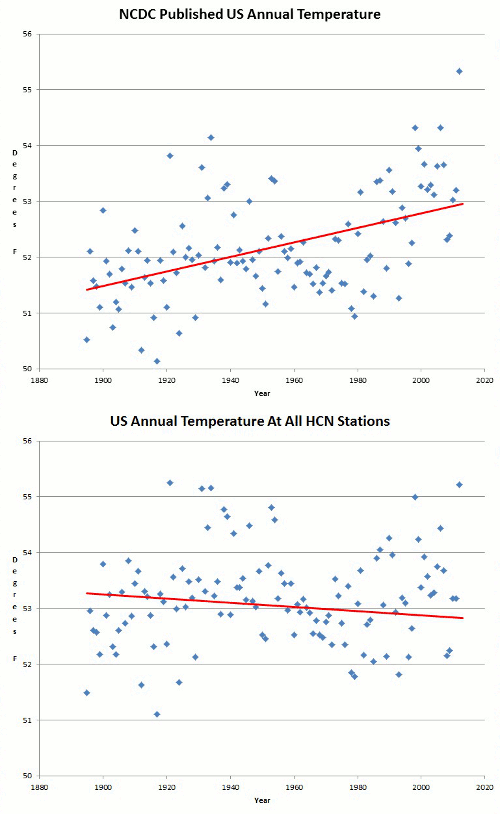
NOAA USHCN saw a change in 2007 that removed an urban adjustment and produced this annual change in US temperatures
. Again we see a cooling of the mid 20th century warm period and an elevation of recent years. .


We are working on a GHCN global change analysis. Charts like this which are common across the globe (This from Alan Cheetham) tell us we will probably find the same.


Once again we see the familiar trait with each progressive adjustment, older high temperatures that are inconvenient to the warmists argument are de-emphasised and later temperatures are over emphasised to give the illusion to the undiscerning eye of unprecedented warming compared to the past. Fortunately people like Joseph D'Aleo keep a watch and a track on these things and are prepared to ask the questions.

Thursday, June 10, 2010

Anthony Watts Discusses His Surface Stations Project

Ever wondered why NASA GISS and the NOAA based NCDC temperature data sets run much hotter than those of say UAH or RSS?


Anthony Watts may well have the answer:

Friday, June 4, 2010

Update On Wind Power Generation

In my earlier series on Power Generation I looked at Wind as a source: (Wind power - part 1, Wind power - part 2, Wind power - part 3). Journalist Terry McCrann has done a recent examination of Wind Power Generation as it applies in Australia in his article and has some interesting conclusions, via Andrew Bolt's blog : If we relied on wind power, Australia would have shut down . (My emphasis added)

image

The great green energy scam is exposed. The above chart shows the total electricity produced from May 13 to May 20 by all Australia’s windfarms, on which we’ve spent billions.

Terry McCrann:

Could any rational person—indeed, even gutless half-rational politician—build our energy supply on the total unreliability of so-called wind power.

This is what our total wind `power’ industry across southeastern Australia—NSW, Victoria and South Australia—delivered in one week in May. To all intents and effective purposes: ZERO power…

When the wind don’t blow the power don’t flow. Further, often the wind don’t blow at the same time, right across southeastern Australia… Further wind can go from very high power deliverability to very little in very short time spans.

So you don’t only need installed back-up power almost equivalent to the wind industry, to pick up the slack when it comes, but you need to keep it running, rendering utterly pointless having the wind power anyway.

Despite all the starry-eyed and empty-headed gazing at the power of the sun, wind is the only `practical’ alternative `renewable’ energy `source’ anytime soon.

Almost all our politicians are committed to 20 per cent alternative/renewable energy by 2020. It means a commitment to blackouts and brownouts—quite apart from unnecessarily higher power charges.

(No link to McCrann’s column.)

To confirm what Terry McCrann was saying I looked at the power generation by wind from all generators on 1st June 2010. This was the result:

The bottom graph shows a combined power peaked at less than 65MW of generation at approximately 4:30 in the morning then very little after that. If it wasn't for back up generation (probably from the La Trobe Valley's brown coal fired generators) much of the South East of Australia would have been blacked out. It also poses the questions, if you have signed up to pay for "green power" and none is available should you be paying the premium that is asked given you are instead being supplied by coal? Is this simply false advertising by the power companies when they cannot guarantee reliable supply? Are the consumers getting what they are paying for?