Thursday, July 7, 2011

Dr Judith Curry - An explanation(?) for lack of warming since 1998

In a follow up to my last post entitled New Study Admits “Global Surface Temperatures Did Not Rise Between 1998 and 2008″ is this analysis by (former AGW believer now sceptic) Dr. Judith Curry of Climate Etc. In it she says:

A new paper has been published in PNAS entitled “Reconciling anthropogenic climate change with observed temperature 1998-2008.”

Reconciling anthropogenic climate change with observed temperature 1998-2008

Robert K. Kaufmann, Heikki Kauppi, Michael L. Mann, and James H. Stock

Abstract. Given the widely noted increase in the warming effects of rising greenhouse gas concentrations, it has been unclear why global surface temperatures did not rise between 1998 and 2008. We find that this hiatus in warming coincides with a period of little increase in the sum of anthropogenic and natural forcings. Declining solar insolation as part of a normal eleven-year cycle, and a cyclical change from an El Nino to a La Nina dominate our measure of anthropogenic effects because rapid growth in short-lived sulfur emissions partially offsets rising greenhouse gas concentrations. As such, we find that recent global temperature records are consistent with the existing understanding of the relationship among global surface temperature, internal variability, and radiative forcing, which includes anthropogenic factors with well known warming and cooling effects.

Link to complete paper [here].

The key argument in their paper is that an increase in coal burning (primarily in China) has increased atmospheric sulfate concentration with a resulting global cooling effect. The data that they use for coal emissions can be found in this spreadsheet from EIA. The paper concludes:

Conclusion

The finding that the recent hiatus in warming is driven largely by natural factors does not contradict the hypothesis: “most of the observed increase in global average temperature since the mid 20th century is very likely due to the observed increase in anthropogenic greenhouse gas concentrations.” As indicated in Fig. 1, anthropogenic activities that warm and cool the planet largely cancel after 1998, which allows natural variables to play a more significant role. The 1998-2008 hiatus is not the first period in the instrumental temperature record when the effects of anthropogenic changes in greenhouse gases and sulfur emissions on radiative forcing largely cancel. In-sample simulations indicate that temperature does not rise between the 1940’s and 1970’s because the cooling effects of sulfur emissions rise slightly faster than the warming effect of greenhouse gases. The post 1970 period of warming, which constitutes a significant portion of the increase in global surface temperature since the mid 20th century, is driven by efforts to reduce air pollution in general and acid deposition in particular, which cause sulfur emissions to decline while the concentration of greenhouse gases continues to rise.

The results of this analysis indicate that observed temperature after 1998 is consistent with the current understanding of the relationship among global surface temperature, internal variability, and radiative forcing, which includes anthropogenic factors that have well known warming and cooling effects. Both of these effects, along with changes in natural variables must be examined explicitly by efforts to understand climate change and devise policy that complies with the objective of Article 2 of the 1992 United Nations Framework Convention on Climate Change to stabilize “greenhouse gas concentrations in the atmosphere at a level that would prevent dangerous anthropogenic interference in the climate system.”

Science News

Science News has is writing an article on this paper (haven’t spotted it yet). Here is the complete comments I provided to the reporter via email:

This paper points out that global coal consumption (primarily from China) has increased significantly, although the dataset referred to shows an increase only since 2004-2007 (the period 1985-2003 was pretty stable). The authors argue that the sulfates associated with this coal consumption have been sufficient to counter the greenhouse gas warming during the period 1998-2008, which is similar to the mechanism that has been invoked to explain the cooling during the period 1940-1970.

I don’t find this explanation to be convincing because the increase in sulfates occurs only since 2004 (the solar signal is too small to make much difference). Further, translating regional sulfate emission into global forcing isnt really appropriate, since atmospheric sulfate has too short of an atmospheric lifetime (owing to cloud and rain processes) to influence the global radiation balance.

The alternative explanation is natural internal variability associated with the ocean oscillations. Since 1999, the Pacific Decadal Oscillation has been shifting from the warm phase (warm phase since 1976) to the cool phase, and has been mostly in the cool phase since 2007. A cool PDO is associated with more frequent La Nina events, which are associated with globally cooler temperatures. The climate model studies cited by the authors do not do a convincing job of ruling out natural internal variability as an explanation, either for the cool period since 1998, and the earlier cool period during 1940-1970.

In summary, the authors have put forward one possible explanation for the lack of warming, but an explanation associated with natural internal variability associated with the ocean oscillations is at least as plausible as the explanation put forward by the authors.

Aerosol forcing

Sulfate from coal burning is but one source of atmospheric aerosol. AGW Observer provides a recent list of papers on aerosol forcing observations. See especially the Remer et al. paper, Fig 5, which shows no trend in global aerosol optical depth during the period 2000-2006. A plot for East Asia also shows no trend regional aerosol optical depth.

I also checked to see what CMIP5 is using for aerosol forcing, see here, but there doesn’t seem to be any simple way to visualize whatever is being used. I found a paper by Jones et al., see Fig. 10, that appears to be the CMIP5 aerosol forcing. Looking at the black curves (historical, to 2005), it is seen that sulfur dioxide emissions peaked during 1960-1980, and then have steadily decreased (a tiny uptick after 2005 is seen in some of the future scenarios). Fossil fuel black carbon has shown a stead increase since 1950, as has fossil fuel organic carbon. I don’t seen any signal in the total aerosol emissions that resembles the coal emissions with a flat trajectory since 1985 and an uptick after 2004 (although the historical data ends in 2005).

There is also a big international project called AEROCOM, that is coordinating the preparation, evaluation and application of global aerosol data sets. However I can’t find anything on their site that provides easy visualization of the global aerosol emissions or forcing.

JC comments: Their argument is totally unconvincing to me. However, the link between flat/cooling global temperature and increased coal burning in China is certainly an interesting argument from a political perspective. The scientific motivation for this article seems to be that that scientists understand the evolution of global temperature forcing and that the answer is forced variability (not natural internal variability), and this explanation of the recent lack of warming supports a similar argument for the cooling between 1940 and 1970. The political consequence of this article seems to be that the simplest solution to global warming is for the Chinese to burn more coal, which they intend to do anyways.

And finally, with the civil heretic discussion fresh in my mind, I checked the personal web pages of each of the co-authors: Robert K. Kaufmann, Heikki Kauppi, Michael L. Mann (not Michael E. Mann, of hockeystick fame), and James H. Stock. These authors (individually and collectively) apparently know a heck of a lot less about atmospheric aerosols (i.e. pretty much nothing) than Freeman Dyson knows about climate change. The authors don’t seem to know much about attribution, either.

This article is listed as a PNAS direct submission, which means that it gets the more rigorous review treatment by the PNAS editors. I would certainly be interested in knowing who reviewed this paper. I suspect that this paper will be criticized from both sides of the AGW debate.

Tuesday, July 5, 2011

New Study Admits “Global Surface Temperatures Did Not Rise Between 1998 and 2008″

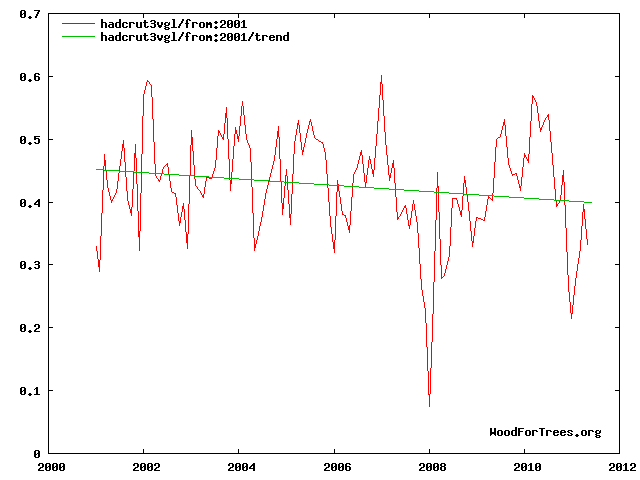
I recently was using the site Wood For Trees after it was suggested to me that there indeed had been either a plateau in temperatures for the last ten years or indeed a small fall depending on which of the four main temperature data sets (GISTEMP, HadCRUT3, UAH and RSS) you chose to use as a reference. I wanted to see for myself and this is what I found:

GISTEMP, despite all the manipulation that James Hansen has put into his data set over the years and the amount of divergence it has achieved compared to the other data sets it shows that for the past ten years there has been no rise in temperature:


This conclusion is supported by the UAH temperature data set:


Yet when we examine the data set from HadCRUT 3 we can see there is indeed a fall in temperature over that period:


And this decrease is repeated when we use the RSS data set:

Now via Watts Up With That comes a peer reviewed study that says that "global surface temperatures did not rise between 1998 and 2008."

The Kaufmann et al 2011 paper (Note: Michael L. Mann is a co-author, not the same as Michael E. Mann of hockey team fame) was embargoed until 8PM GMT (12PM PDT) today, and we have an advance copy thanks to Dr. Benny Peiser .

Here is the PDF file
: pnas.201102467

The headline from the abstract:

Given the widely noted increase in the warming effects of rising greenhouse gas concentrations, it has been unclear why global surface temperatures did not rise between 1998 and 2008.

But in the conclusion:


The finding that the recent hiatus in warming is driven largely by natural factors does not contradict the hypothesis: “most of the observed increase in global average temperature since the mid 20th century is very likely due to the observed increase in anthropogenic greenhouse gas concentrations (14).”

From the GWPF:

Comments by Dr David Whitehouse on the PNAS paper Kaufmann et al.

Reconciling anthropogenic climate change with observed temperature 1998 – 2008.

It is good news that the authors recognise that there has been no global temperature increase since 1998. Even after the standstill appears time and again in peer-reviewed scientific studies, many commentators still deny its reality.
We live in the warmest decade since thermometer records began about 150 years ago, but it hasn’t gotten any warmer for at least a decade.

The researchers tweak an out-of-date climate computer model and cherry-pick the outcome to get their desired result. They do not use the latest data on the sun’s influence on the Earth, rendering their results of academic interest only.


They blame China’s increasing coal consumption that they say is adding particles into the atmosphere that reflect sunlight and therefore cool the planet.
The effect of aerosols and their interplay with other agents of combustion is a major uncertainty in climate models. Moreover, despite China’s coal burning, data indicate that in the past decade the amount of aerosols in the atmosphere has not increased.

The researchers seek to explain the temperature standstill between 1998 and 2008. They say that the global temperature has increased since then.


This is misleading. There was an El Nino in 2010 (natural cyclic warming) but even that did not raise temperatures above 1998. In fact the standstill has continued to 2010 and 2011 appears to be on course to be a cooler year than any of the preceding ten years.

Tweaking computer models like this proves nothing. The real test is in the real world data. The temperature hasn’t increased for over a decade. For there to be any faith in the underlying scientific assumptions the world has to start warming soon, at an enhanced rate to compensate for it being held back for a decade.

Despite what the authors of this paper state after their tinkering with an out of date climate computer model,
there is as yet no convincing explanation for the global temperature standstill of the past decade.

Either man-made and natural climatic effects have conspired to completely offset the warming that should have occurred due to greenhouse gasses in the past decade, or our estimation of the ‘climate sensitivity’ to greenhouse gasses is too large.


This is not an extreme or ‘sceptic’ position but represents part of the diversity of scientific opinion presented to the IPCC that is seldom reported.

Saturday, May 28, 2011

New Study Links Cosmic Rays To Aerosols/Cloud Formation Via Solar Magnetic Activity Modulation

Following my recent theme on Cosmic Rays and Cloud formation is this recent peer reviewed study covered via Watts Up With That:

New study links cosmic rays to aerosols/cloud formation via solar magnetic activity modulation

Scientists at Aarhus University (AU) and the National Space Institute (DTU Space) show that particles from space create cloud cover


New input to the United Nations climate model: Ulrik Ingerslev Uggerhøj, Physics and Astronomy, AU, along with others including Jens Olaf Pepke Pedersen and Martin Bødker Enghoff, DTU Space, have directly demonstrated in a new experiment that cosmic radiation can create small floating particles – so-called aerosols – in the atmosphere. By doing so, they substantiate the connection between the Sun’s magnetic activity and the Earth’s climate.

With the new results just published in the recognised journal Geophysical Research Letters, scientists have succeeded for the first time in directly observing that the electrically charged particles coming from space and hitting the atmosphere at high speed contribute to creating the aerosols that are the prerequisites for cloud formation.

Clouds, which are drops of water, occur more easily when water vapour in the atmosphere can condense around particles – dust or large clusters of molecules. Researchers have now shown that electrons caused by cosmic radiation can create small particles that can grow in the atmosphere into such cloud condensation nuclei. This is interesting in the light of the controversial theory proposed by Henrik Svensmark, DTU Space, who postulates a correlation between solar activity and the Earth’s temperature: when the Sun’s activity increases – and thereby magnetic fields (seen as more sunspots) – more of the cosmic particles deflect and fewer therefore reach the Earth’s atmosphere, whereupon there is less cloud formation and the temperature rises on the Earth’s surface. And conversely: when the magnetic field is weakened, the temperature drops. (Graphics: DTU Space)

The more cloud cover occurring around the world, the lower the global temperature – and vice versa when there are fewer clouds. The number of particles from space vary from year to year – partly controlled by solar activity. An understanding of the impact of cosmic particles – consisting of electrons, protons and other charged particles – on cloud formation and thereby the number of clouds, is therefore very important as regards climate models.

With the researchers’ new knowledge, it is now clear that here is a correlation between the Sun’s varying activity and the formation of aerosols in the Earth’s atmosphere. Initially, the researchers have demonstrated that there is a correlation, and they will therefore now carry out systematic measurements and modellings to determine how important it is to the climate. The new studies will be made at DTU Space in Copenhagen, with support that includes a new grant of DKK 2 million (approximately EUR 270,000) from the Danish National Research Councils.

Experiment in a climate chamber

Section of ASTRID – Denmark’s largest particle accelerator – at Aarhus University, from which scientists have sent electrons into a climate chamber and created conditions similar to the atmosphere at the height where clouds are formed. Simply by comparing situations in the climate chamber with and without electron radiation, researchers can directly see that increased radiation leads to more aerosols. These aerosols are interesting because they can make water vapour in the atmosphere condense into drops of water – i.e. clouds. (Photo: AU)

In a climate chamber at Aarhus University, scientists have created conditions similar to the atmosphere at the height where low clouds are formed. By irradiating this artificial atmosphere with fast electrons from ASTRID – Denmark’s largest particle accelerator – they have also created conditions that resemble natural ones on this point.
Simply by comparing situations in the climate chamber with and without electron radiation, the researchers can directly see that increased radiation leads to more aerosols.
In the atmosphere, these aerosols grow into actual cloud nuclei in the course of hours or days, and water vapour concentrates on these, thus forming the small droplets the clouds consist of.

Background

Based on the correlation between the level of activity of the Sun and the global temperature of the Earth, the Danish climate researcher Henrik Svensmark proposed a controversial theory in the late 1990s: that there could be a correlation between the intensity of the cosmic radiation that hits the Earth – and which is affected by the activity of the Sun – and the number of clouds formed.
With the experiment in Aarhus, the research group has now taken one step closer to being able to demonstrate this relationship. There is much to indicate that climate models must hereby take cosmic radiation into consideration. In doing so, the new results provide hope for better climate models that can describe the Earth’s temperature and climate more accurately.

Comments from three of the scientists behind the experiment:

Senior Scientist Jens Olaf Pepke Pedersen, DTU Space, says:

“Aarhus University has outstanding facilities that enable us for the first time to carry out a very direct test of the theory on cosmic particles causing droplet formation in the atmosphere.”

Scientist Martin Bødker Enghoff, DTU Space, adds:

“Before we can say how great the effect is, it’s clear that our results must be verified – just as more measurements and model computations need to be made. However, we can already reveal with no doubt whatsoever that there is an effect.”

“It’s a pleasure to see these results in climate research being achieved at our accelerator. Actually, it’s only possible to do corresponding research at CERN – the joint European research centre,” says Associate Professor Ulrik Uggerhøj, Department of Physics and Astronomy, Aarhus University.

Facts about the experiment

A chamber contains air with precisely balanced amounts of sulphur dioxide, ozone and water vapour irradiated with electrons. Sunlight is a necessary ingredient for aerosol formation in the natural atmosphere, and it is imitated in the climate chamber by a lamp that emits ultraviolet light. Natural atmospheric processes such as the formation of sulphuric acid are thus imitated, and these are an important ingredient in the aerosols. When electrons from the accelerator irradiate the air mixture, an increase takes place in the production of aerosols, which act as nuclei for the production of cloud droplets. In previous SKY experiments conducted by DTU Space in Copenhagen, cosmic radiation was simulated by gamma radiation, and the scientists saw here that the gamma rays could also form aerosols. In the new experiment with the energy-rich electrons from the ASTRID accelerator, there is much more resemblance to the cosmic rays that occur in nature.

Competitors hot on their heels

A major international research group at the European Particle Research Centre (CERN) in Geneva, Switzerland, has worked for several years on demonstrating the correlation that the Danish researchers have found, and the group has announced that its members are also on the way with their first extensive results. Compared with the CERN project, the Danish scientists have an extremely modest budget, but when it comes to producing particles resembling cosmic ones, the facilities at Aarhus University are equal to the most advanced facilities in the world.

Associate Professor Ulrik Ingerslev Uggerhøj goes into more detail in the video interview below (in Danish only)

Here’s the abstract

GEOPHYSICAL RESEARCH LETTERS, VOL. 38, L09805, 4 PP., 2011
doi:10.1029/2011GL047036

Aerosol nucleation induced by a high energy particle beam

Key Points
  • Cosmic rays increase nucleation rate
  • A particle beam is not needed for experiments
  • Ions are important for atmospheric nucleation rate

Martin B. Enghoff

National Space Institute, Technical University of Denmark, Copenhagen, Denmark

Jens Olaf Pepke Pedersen

National Space Institute, Technical University of Denmark, Copenhagen, Denmark

Ulrik I. Uggerhøj

Department of Physics and Astronomy, University of Aarhus, Aarhus, Denmark

Sean M. Paling

Department of Physics and Astronomy, University of Sheffield, Sheffield, UK

Henrik Svensmark

National Space Institute, Technical University of Denmark, Copenhagen, Denmark

We have studied sulfuric acid aerosol nucleation in an atmospheric pressure reaction chamber using a 580 MeV electron beam to ionize the volume of the reaction chamber. We find a clear contribution from ion-induced nucleation and consider this to be the first unambiguous observation of the ion-effect on aerosol nucleation using a particle beam under conditions that resemble the Earth’s atmosphere. By comparison with ionization using a gamma source we further show that the nature of the ionizing particles is not important for the ion-induced component of the nucleation. This implies that inexpensive ionization sources – as opposed to expensive accelerator beams – can be used for investigations of ion-induced nucleation.

Received 8 February 2011; accepted 31 March 2011; published 12 May 2011.

Citation: Enghoff, M. B., J. O. P. Pedersen, U. I. Uggerhøj, S. M. Paling, and H. Svensmark (2011), Aerosol nucleation induced by a high energy particle beam, Geophys. Res. Lett., 38, L09805, doi:10.1029/2011GL047036.

Latest News From CERN CLOUD Experiment

In an earlier post I made mention of an experiment being conducted by CERN called CLOUD (‘cosmics leaving outdoor droplets’) which was an experiment designed to investigate the link between solar activity and the climate, to test the theory that cosmic rays spur the formation of particles in the air that nucleate clouds, in turn making skies cloudier and the planet cooler. They are doing this by using a particle beam from CERN as a stand-in for cosmic rays, and firing them through an ultra-clean steel chamber filled with select atmospheric gases, to see if and how particles that could nucleate clouds are formed.

Via Watts Up With That comes an update on where the experiment is currently at:

Update on the CERN CLOUD experiment

According to Nigel Calder’s Blog, CERN’s CLOUD experiment (testing Svensmarks’s cosmic-ray theory) shows a large enhancement of aerosol production and the results are due for release in 2 or 3 months’ time. There is a short Physics World interview with Jasper Kirkby which is worthwhile viewing and was published a couple of days ago…

Further down, we have some information from Bishop Hill liveblogging from the recent conference in Cambridge, UK where he makes notes on Q&A with Svensmark, plus a Josh livetoon.

From Physics World Head in a CLOUD:

In this special video report for physicsworld.com CLOUD project leader Jasper Kirkby explains what his team is trying to achieve with its experiment. “We’re trying to understand what the connection is between a cosmic ray going through the atmosphere and the creation of so-called aerosol seeds – the seed for a cloud droplet or an ice particle,” Kirkby explains.

The CLOUD experiment recreates these cloud-forming processes by directing the beamline at CERN’s proton synchrotron into a stainless-steel chamber containing very pure air and selected trace gases.

One of the aims of the experiment is to discover details of cloud formation that could feed back into climate models. “Everybody agrees that clouds have a huge effect on the climate. But the understanding of how big that effect is is really very poorly known,” says Kirkby.


Bishop Hill liveblogs from Cambridge about Q&A with Henrik Svensmark:

  • Solar effect appears to be large. If exclude solar or regime change, then it makes anthropogenic look much bigger. These effects are not well covered by climate models.
  • Can effect be seen in climate? Use ocean heat content. Forcings = volcanoes, gcr, anthropogenic and a regime change in 1977. Solar effect ~1Wm-2, compares well with Shaviv. If remove solar effect left with apparent regime change in 1977. This can be seen in eg tropospheric temps.
  • Coronal mass ejections – decrease in gcrs at earth – forbush decrease. Is there an atmospheric response? Liquid water in clouds over oceans fall after forbush decrease. Ditto in low clouds etc. Aerosols ditto
  • Always lots of nucleation centres in atmosphere. Is this right?
  • Use trace gases in atmosph concentrations. Change amount of ionisation. See if you get more aerosol particles. SKY experiment.
  • Correlation between low clouds and GCRs – but need mechanism. Ions?
  • Discussion of LIA and solar. Solar irradiance too small to explain Need amplification mechanism – clouds.
  • Get correlations between eg stalagmite 18O and solar variability
  • One particle entering atmosphere generates shower of particles – incl ions which change chemistry
  • CRs accelerated by solar events – supernovae.