







It has been said that nothings sells newspapers like Bad News. In fact studies have been conducted and found that media sales actually do drop on good news cycles. Bearing that in mind then is it any wonder that just about all aspects of the media (both mainstream and not) have been keen to post a daily deluge of stories from either scientists or politicians who use or promote alarmism as their modus operandi. Scientist who promote an more sceptical or pragmatic view are rarely printed (not because they are necessarily wrong), but because good news doesn’t sell. Many in the media also display an open bias when conducting interviews either by only representing the believers side of the story, by stacking panels with a great many advocates for AGW against maybe one sceptic and then limit the sceptics ability or time to respond to issues raised ,or indeed by publicly denigrating the sceptic before and during the interview.
According to Professor Bob Carter in his November 2008 article “The Futile Quest for Climate Control” on the topic of the media he wrote:
The climate change hysteria in the media has a life of its own. Ask a web search engine to supply you with references to “global warming” and it will provide a daily haul of ten to twenty alarmist newspaper articles from throughout the world. Many of these stories have as their basis real scientific results from real scientists, but by the time the results been processed through public relations staff and compliant media commentators, the result is group-think, political correctness and frisbee-science of the high order. A scan through headlines alone, which range from the silly to the ridiculous, will remove any doubt that the media treatment of climate change is unbalanced. Reading the articles themselves simply serves to confirm intentional scaremongering and breath taking scientific ingenuousness.
Alarmist climate writing invariably displays one or more of three characteristics. First, it may be concerned with the minutiae of meteorological measurements and trends over the last 150 years in the absence of a proper geological context. Second, it may raise alarm about things that are known to change naturally irrespective of human causation, such as ice melting, sea level change and changes in species’ ranges. Third, there is an almost ubiquitous over reliance on the outputs of unvalidated computer model projections – that is, untestable virtual reality is favoured over actual real world data.
On top of such slanted reporting, and in service of the third example just given, weasel words have become an invaluable aid for engineering public alarm about global warming. “If”, “might”, “could”, “probably”, “perhaps”, “expected”, “projected” , “modelled”…Wonderful words, so wonderful that journalists and other writers scatter them throughout their articles on climate change like confetti. The reason is that – in the absence of hard evidence for damaging human-caused climate change- public attention is best captured by making assertions about “possible” change. Using computer models in support, virtually any type of climate hazard can be asserted as a possible future change.
….The British commentator Melanie Phillips summarised it well:
“The way global warming is being reported by the science press is a scandal. In selecting only those claims that support a prejudice and disregarding evidence that these claims are false, it is betraying the basic principles of scientific inquiry and has become instead an arm of ideological propaganda.”
Finally, for all the problems listed above, and much to the outrage of warming alarmists, it should be acknowledged that a handful of quality newspapers do provide a more balanced public discussion of global warming issues. Such papers include the “Wall Street Journal”, the London “Telegraph” stable, the Canadian “National Post”, the Melbourne “Business Age” and “The Australian”. These publications, and a few others, are playing a vital role in keeping the public informed of both sides of the climate change issue. Tellingly, however, no Australian television station comes even close to providing equivalently balanced commentary; and neither does that paragon of broadcasting virtue, the British Broadcasting Corporation.
This view of the media is supported by Allan Taylor in his article:
“Why do so many people believe in catastrophic global warming?”, where he says: The major TV and radio news media (BBC, DW, ABC, CNN et al) are just propaganda vehicles for the global warming cause and promote renewable resources, carbon emissions trading and red herrings ad nauseam. Only very rarely, and then reluctantly, will they broadcast anything contrary to this belief system.
It should be noted that Australian print media such as “The Age” (as opposed to its business section), “ The Sydney Morning Herald” and other Fairfax media sites, the ABC, SBS, Seven/Prime, Nine/Win/NBN, Ten television stations and the Sky News on pay TV would all fit into this category too. An example is from the ABC's Business Lateline program, where presenter Ticky Fullerton interviewed Professor Ian Plimer:
As she starts the interview she ensures she rings the leper bell on her guest to let the viewers know that in her opinion this persons opinions are not to be taken seriously:
He is a geologist, not a climatologist… Ian Plimer by definition works closely with the mining industry.
She then attacks the person that she perceives is threatening her faith
You are a greenhouse heretic… Is this scepticism genuine, or it it also about economic self interest?
From an Andrew Bolt article that discussed this interview:
So let’s see if Rajendra Pachauri, head of the IPCC, is similarly introduced on Lateline as “a mining engineer and economist, not a climatologist” who “by definition works closely with green groups and warming believers”:
Well, we are joined in the studio by the chairman of the Nobel Prize winning Intergovernmental Panel on Climate Change, Dr Rajendra Pachuari. Dr Pachauri is an economist, engineer and environmental scientist and he’s been the head of the IPCC for the past six years. Just tonight he was awarded an honorary doctorate of science from the University of NSW.
It would appear not, but then he is what she would consider to be "one of the good guys."
Tim Flannery, then, is introduced as “a paleontologist and mammalogist, not a climatologist” who “by definition works closely with people who pay him to scare us about global warming:“
Joining us now is Professor Tim Flannery, arguably Australia’s best known popular scientist. He’s also the author of The Weather Makers and he was recently named Australian of the Year.
So, no then! Also, never are any of his wildly alarmist predictions questioned for accuracy. He is given a warm fireside chat approach to his interview and is allowed to promote himself unchecked.
For interviewee's like Professor Plimer, however, the interruptions and conjecture thrust upon them are constant and often designed to give throw the guest off balance and try to trip them up on any minor detail without clear air to respond. Also all details are examined in excruciating detail. Even the titles given to their segments are provocative in their use of words. For example from the ABC's Lateline program with Tony Jones: Ian Plimer discusses his book denying global warming. This is despite in the interview Jones asks:
TONY JONES: OK, but this mistake about what NASA did to its figures, about global mean temperatures, repeated on a huge number of blogs put out by climate sceptics - now is that where you got your information?
IAN PLIMER: Well, I don't know what a climate sceptic is. Could you explain to me what a climate sceptic is?
TONY JONES: Someone sceptical of climate change.
IAN PLIMER: I'm not. I'm arguing that when you look at the history of the planet - when you look at the history of the planet, climate is always changing. Now, you're pushing these points very hard, Tony. Now, if I embrace your party line...
TONY JONES: It's not a party line.
IAN PLIMER: Are you going to respect me in the morning, when I embrace your party line?
Fortunately, Professor Plimer isn't as easily rattled in an interview as people like Tony Jones would have hoped. Other examples of media bias are contained in part two of this post.
Saturday, August 29, 2009

Australian Activists and Alarmism

Greg Bourne (CEO, WWF-Australia and ‘expert panellist’ for the aftermath of the Great Global Warming Swindle aired on the ABC) ( Pictured above) has moved away from his core business of advocacy for animals and instead has become a vocal climate change activist.
"We must shift in the way we go about our business. We must deliberately build resilience in our environment, build resilience in our society and start a revolution in our economy. The responsibility that befalls our generation; the card that has been dealt to us, is to turn the corner; to move away from an ethos that has seen us mine the planet to pay for the present, and towards an ethos that focuses on securing a sustainable future."
“Climate change is threatening our way of life and the planet we all share.”
“Greenhouse emissions continue to climb and anything more than a two-degree rise in our temperature “could have” devastating consequences”.
Note the use of weasel words like "could have" is a way of getting your scare across without actually committing to anything. This is a common tactic and use of language by many alarmists.
“Global warming “could” eradicate as many as 25 per cent of all living species on earth.”
“Here in Australia our current drought-flood cycle will intensify, putting lives at risk and reducing our water security.”
“Despite the grim outlook, it is not too late and every single one of us can help to reverse current trends”.
“Almost 40 per cent of the solution to combating climate change is contained in simple acts of using energy more efficiently”.
Labelling Big business:
“Big polluters have known for 20 years that the Government would regulate carbon pollution. …Either way, why should the public pay for their negligence or deception?”
“Companies are complaining that they will be forced overseas, but this is unlikely. Even after the Rudd Government's emissions trading scheme starts in 2010, Australia will be one of the most attractive countries in the world for big companies to invest. We will still have some of the lowest energy prices in the world; some of the best electricity, port, transport and communications infrastructure and some of the largest mineral reserves. …. I think its time for directors and managers of the major industries to stand up and tell us why they have been taken by surprise. Were they aware of climate change but just chose to take a business risk and ignore it? Were they simply negligent and failed to prepare to avoid an obvious risk? Or, are they hoping for a big profit underwritten by the Australian public? If not, it is time for them to get on board, support the Government's carbon pollution reduction scheme and stop cadging for public handouts.”
To name but a few. Organisations like the CSIRO and Bureau of Meteorology which receive government funding in relation to climate change also now regularly use these same alarmist tones. In doing so they secure their funds in to the future.
Dr. James Hansen commended Australia's Prime Minister Kevin Rudd in 2008 ....the following Australian climate, paleoclimate and Earth scientists to provide further elaboration of the science reported in my attached paper (Hansen et al., 2008). Again there are those same familiar names:
Professor Barry Brook, Professor of climate change, University of Adelaide
Dr Andrew Glikson, Australian National University
Professor Janette Lindesay, Australian National University
Dr Graeme Pearman, Monash University
Dr Barrie Pittock, CSIRO
Dr Michael Raupach, CSIRO
Professor Will Steffen, Australian National University
The climate clique is alive and well, also if Dr. Hansen recommends them, clearly they must follow his lines of thought and expression in alarmism.
Australian Scientists and Alarmism
In June 2008 a joint statement was issued on climate change at the Manning Clark House Conference at Australian National University, Canberra. In this statement they said the usual array of alarmist statements:
Global warming is accelerating. The Arctic summer sea ice is expected to melt entirely within the next five years, - decades earlier than predicted in the 2007 Intergovernmental Panel on Climate Change (IPCC) 4th Assessment Report. Scientists judge the risks to humanity of dangerous global warming to be high. The Great Barrier Reef faces devastation. Extreme weather events, such as storm surges adding to rising sea levels and threatening coastal cities, will become increasingly frequent. There is a real danger that we have reached or will soon reach critical tipping points and the future will be taken out of our hands. The melting Arctic sea ice could be the first such tipping point. Beyond 2ºC of warming, seemingly inevitable unless greenhouse gas reduction targets are tightened, we risk huge human and societal costs and perhaps even the effective end of industrial civilisation. We need to cease our assault on our own life support system, and that of millions of species. Global warming is only one of many symptoms of that assault. Peak oil, global warming and long term sustainability pressures all require that we reduce energy needs and switch to alternative energy sources. Many credible studies show that Australia can quickly and cost-effectively reduce greenhouse gas emissions through dramatic improvements in energy efficiency and by increasing our investment in solar, wind and other renewable sources. The need for action is extremely urgent and our window of opportunity for avoiding severe impacts is rapidly closing. Yet the obstacles to change are not technical or economic, they are political and social. We know democratic societies have responded successfully to dire and immediate threats, as was demonstrated in World War II. This is a last call for an effective response to global warming.
The 200 conference delegates, contained some familiar names including:
Climate scientists: Prof Barry Brook, Prof Ian Enting, Prof Janette Lindesay, Prof Graeme Pearman, Dr Barrie Pittock, Prof Will Steffen;
Earth and prehistory scientists: Dr Geoff Davies, Dr David Denham, Dr Andrew Glikson (conference convener), Dr Geoffrey Hope, Prof Malcolm McCulloch, Dr Bradley Opdyke;
Political leaders: Senator Lyn Allison, Dr Carmen Lawrence, Barry Jones;
Environmental lawyer: Phillip Toyne;
Health and population experts: Prof Stephen Boyden, Dr Bryan Furnass (conference co-convener), Prof Tony McMichael, Dr Sue Wareham;
Humanists: Dr Paul Collins, Tony Kevin, Dierk von Behrens;
Poet: Mark O'Connor.
Thursday, August 27, 2009
Australian Scientists and Alarmism - Professor Barry Brook

Professor Barry Brook, a biologist who is the Director of the Research Institute for Climate Change and Sustainability at the University of Adelaide and the Foundation Sir Hubert Wilkins Chair of Climate Change. (Pictured above). By title at least, he must be the eminently qualified person in Australia on Climate Change. So you would expect him to discuss the topic in a calm and rational manner, displaying the science for all to see and not resort to name calling and demonising of those that don't share his views or understandings on climate change.As with many other alarmists he is dismissive and displays contempt towards anyone that does not share his view. Instead he often does the latter rather than the former and seems not to be able to discuss the science with the public except in terms of alarmism.
Active and forthright public communication of science is not only an obligation of scientists, but a critical necessity. This is especially true for climate change and environmental sustainability, where we are perilously close to running out of time.
"Climate scientists don't use temperature charts to 'prove' global warming."
“nature has been holding climate change at bay (!!!) but all hell is about to break loose from 2009.”
When talking about sceptics or any one who opposes his views:
“Do not feed the trolls”
“in climate science and policy there were still a few, apparently well-educated people who continued to deny the vast body of scientific knowledge and analysis.” ..they are variously called sceptics, aerialists, contrarians, delayers or deflationists.
.."Whatever the label you attach to them, they are all cut of the same anti-intellectual cloth,"
"Some people will attempt to hijack science for political or ideological reasons and in doing so besmirch science's public image,"
"They are good at doing this and they often exert a disproportionate influence on policy.”
"Groups with vested interests in business-as-usual will attempt to push so-called scientific evidence to support their claims.”
Professor Brook uses these lines again and again (see below at the bottom of this post).
"In fact they are at best drawing selectively on a small part of the evidence, or at worst relying on junk science - that is, outdated, discredited or fabricated data and ideas."
“if confronted with good science, deniers sidestepped valid critiques and ignored counter-evidence.”
"They are hard to pin down because they don't want a serious scientific debate,"
In an exchange with Herald Sun Columnist Andrew Bolt, Professor Brook demonstrated his contempt for those he believes are beneath him to argue with, where instead of rebutting Bolt with undeniable facts, he instead uses (according to Bolt) a series of misrepresentations and evasions to make his case.
Professor Brook even tries a school yard “gotcha” with this comment in an attempt to prove his superior intellect over Bolt:
“After all, to be consistent, if all those extra greenhouse gases really don't cause global warming, and if the sun is now in a cool phase, then why haven't the thermometers immediately dropped back to the levels of the 19th century?”
Bolt responded with :
Could Brook be seriously arguing that global temperatures zip up and down so instantly? That there really is but one influence on them? Is he really holding out this clumsy "gotcha" as proof that the world has in fact warmed, despite what the temperature measurements tell us? As proof that man's gases must therefore be responsible for any warmth that we did in fact have? Seems so:
Then finally Professor Brook offers some scientific argument to support his rebuttal of a graph put up by Bolt in his column showing the seas had stopped rising and were possibly even contracting:
Andrew also claims that the seas have stopped rising because of a dip in 2007. But he left out the standard "inverse barometer" correction – with this the blip then vanishes.
However, on that one piece of scientific evidence offered by Brook he is proved incorrect by the University of Colorado site which monitors the satellite data of sea level rises which adds:
"The inverted barometer does not have much apparent effect on the global mean sea level because the ocean as a whole is not compressible.”


Without correction is the top graph, with correction is the bottom one. Following correction it is obvious that "the blip" is indeed still there.
A further twelve months has passed and what is now becoming very clear is that the blip a Professor Brook referred to it has become a plateau and the sea levels has risen (if at all) by only the smallest of margins since 2005.

This become even more obvious once all the dots and misleading black trend line is removed. the 20mm line crosses the sea level first in 2005. Four years later it is still barely above that line but is heading back towards it.

What makes this one encounter so interesting is that fact that one of the countries most eminently titled climate scientists is not able to use the science he proclaims is there to answer the questions raised by a newspaper columnist.
This is now not the only time this has happened that pro climate change climate scientists have been unable to satisfactorily answer the posing questions put to them by people who are not their peers. On June 15th 2009 Family First Senator Steve Fielding presented three questions on Climate Change he wanted answered prior to voting for or against the Rudd governments Carbon Pollution Reduction Scheme legislation which was due in August. The questions were put to the Minister Penny Wong and her scientific advisers Professor Penny Sackett (Chief Scientist of Australia) and Professor Will Steffen (Director, ANU Climate Change Institute). After trying to get Senator Fielding to alter his second question more to what they wanted to answer, the meeting concluded with the Minister and her team "getting back" to Senator Fielding at a later date. Again the question has to be why, if the science is so settled couldn't they satisfactorily answer three straight forward questions put by Senator Fielding to his and his teams satisfaction? A full outline of that meeting and what was asked and what was answered is here.
So going back to Professor Brook's exchange with Andrew Bolt, was Professor Brook drawing selectively on a small part of the evidence, that was outdated? Why when he was confronted with good science, did he choose instead to sidestep valid critiques and ignored counter-evidence? Was Professor Brook in his own words perhaps being " hard to pin down because he didn't want a serious scientific debate?"
But this isn’t the only time Professor Brook has been dismissive of opinions or information that doesn’t suit his cause. With regard to McIntyre's debunking of the Hockey stick graph:
There's really no need to respond, as this hoary old chestnut has already been gathered, roasted and eaten. If the folks at Climate Audit choose not to keep up to date, or to ignore any refutation, that's their limitation.
So again Professor Brook when “confronted with good science” In his own words “sidestepped valid critiques and ignored counter-evidence.”
Of course Professor Brook isn’t afraid to wheel out this hoary old chestnut when it suits his cause, as again (this time on the ABC) he uses:
Groups with vested interests in business-as-usual (such as tobacco spokespeople or fossil fuel lobbyists) will attempt to push so-called "scientific evidence" to support their claims. In fact they are at best drawing selectively on a small part of the evidence, or at worst relying on "junk" science - that is, outdated, discredited or fabricated data and ideas.
Look familiar at all?
Because as we all know, all deniers are of course “in the pay of Big Oil” or are “Tobacco scientists" , aren't they?
Australian Scientists and Alarmism - Professor Matthew England

Professor Matthew England (PhD, Director, Climate and Environmental Dynamics Laboratory (CEDL), University of New South Wales). (Pictured above) is, like many of his fellow scientists from the believer's camp, adamant that the debate is over and that sceptics need to be treated with scorn. He seems to have blinded himself to any other possibilities and seems very obsessed with funding for his cause, as can be seen in comments below:
He has some strong opinions on Al Gore’s Movie:
Gore captivates his audience with a compelling presentation. He shows graphics that climate scientists and their students might have seen a thousand times, yet he articulates their content with clarity. And he gets it all right. I watched the show waiting for him to slip up, to get something wrong, it doesn't happen.
Conservative commentators and the so- called "climate change sceptics" are up in arms: what does a politician know about climate change? Well, it turns out he knows a lot more about it than the sceptics.
Gore takes his audience on a tour of the changing planet, interspersed with graphs drawn out of any climate textbook. The result is compelling viewing.
….Now Gore brings the real stuff to the box office. Don't be fooled by self-anointed experts telling you he has got it wrong. He hasn't. You get to see what you might see in any university climate lecture, but on the big screen and told by a man once touted as the next president of the US.
Climate change sceptics are now so few in number that they are almost household names, regularly paraded by the media under the false guise that there is unrest and controversy about climate change and whether it's real.
The more fervent among the sceptics clan claim this is just a scientific conspiracy to misinform in the hope of securing more funding, presumably to do yet more misinforming and perpetrate a bizarre cycle of mistruths.
The irony is that the emergence of consensus views on climate change should ultimately mean an increase in funding to address the problem, not study it. One thing is certain: scientists are an ambitious bunch and nobody gets a prize for fraudulent science. They get struck off the payroll.
Everybody has an opinion on climate change. Do they read the scientific literature? Have they studied the textbooks? Gore has, so he deserves his soapbox.
Checking his glowing and supportive assessment of Al Gore's movie in this link, we find that it is in fact full of major errors. Thirty five to be precise. Nine of which were ruled on by Justice Burton in a British court of law. Others think there may be even more errors in Gore's film. All of which Professor England was ignorant of or more likely chose to ignore, when he made statements like: ...he gets it all right. I watched the show waiting for him to slip up, to get something wrong, it doesn't happen. And these ones: ….Now Gore brings the real stuff to the box office. Don't be fooled by self-anointed experts telling you he has got it wrong. He hasn't.
As they did not support either Gore's or his position and thus were deemed to be "Inconvenient truths". It lends support to the old saying that: "None are so blind as those that will not see!"
When Professor England says things like Climate change sceptics are now so few in number that they are almost household names he must have be unaware of all of these scientists, that are too numerous to be mere household names. Or even these ones who are also too numerous to be considered few in number or mere household names. However, it is true that many notable scientists that have graced our televisions in the past such as David Bellamy are indeed sceptics of climate change. So perhaps that was what he was referring too instead?
It is also interesting when Professor England says this in an attempt to slur those that are presenting counter views to his own as nothing more that money hungry liars, who are prepared to peddle any non-sense just to achieve a pay cheque: The more fervent among the sceptics clan claim this is just a scientific conspiracy to misinform in the hope of securing more funding, presumably to do yet more misinforming and perpetrate a bizarre cycle of mistruths. Yet in reality we find that many of the scientists and advocates that are presenting alarmist views are most often the ones making large sums of money as they hype the scares. Money from both government sources and private. Yet many are freely admitting that they exaggerate in order to capture attention and as a result funding for their cause. Yet he says it is exclusively the domain of the sceptics to do this.
Also when Professor England says: Everybody has an opinion on climate change. Do they read the scientific literature? Have they studied the textbooks? Gore has, so he deserves his soapbox. Are we to assume that he is saying that Al Gore having read some texts that he (Professor England) approves of that he is indeed more knowledgeable than these learned people of The American Physical Society? No doubt they too are some of the sceptics who are so few in number.
Next, we will have a look at something that is near and dear to many climate scientists hearts now that they have captured the attention of government bodies worldwide, Professor England's repeated calls for funding for his cause (already mentioned above):
“FUNDING for the Australian climate science research effort needs doubling,”
“federal and state governments needed to rethink their approach to climate science research funding. The focus has been recently skewed to adaptation, "but they need also need to remember to resource the science that informs climate adaptation policies, such as the next generation climate models.''
Like the ones that Professor England produces. So doing a quick examination of Professor England’s listed funding from his own website in the section of funding arrangements shows an interesting story:
From what I could gather these were his non-climate science specific related grants:
CSIRO Flagship Fellowship, 2005: Southern Ocean teleconnections to Australian climate, $72,000.
Australian Antarctic Science Grant, 2004: Variability and stability of Antarctic Bottom Water, $56,100.
UNSW Goldstar Award, 2004: $30,000.
UNSW Faculty Research Grant, 2003: $15,000.
UNSW UPRS, 2002: Southern Ocean water-masses: stability, variability and long-term change, $15,000.
ARC Small Grant, 2000: A Southern Ocean Model Intercomparison Project, $11,000.
ARC Small Grant, 1999: A Global Ocean Model Intercomparison Project, $9,000.
Australian Academy of Science, 1997: Formation and stability of Antarctic Bottom Water.
ARC Small Grant, 1997: Circulation, dynamics and water-mass formation in the Southern Ocean, $20,000.
ARC Small Grant, 1996: Topographic effects in ocean circulation models, $12,000.
UNSW VC's Research Fellowship, 1995-1997: $163,000 (Salary + on-costs + $15,000 project costs).
And these were his climate science related grants as the Chief Investigator :
Australian Research Council (ARC) Grants:
ARC Federation Fellowship, 2006-2010: Genesis of Australian climate extremes in the Southern Hemisphere extratropical ocean-atmosphere. FF0561734 Total funding over 5 years: $1,500,000 + matching support from UNSW.
ARC-Discovery DP0881798 (England, M.H., W. Sijp), 2008-2010: Coupled ocean-carbon-atmosphere feedbacks in the global climate system, $415,000.
ARC-Discovery DP0667075 (England, M.H., A. Muller), 2006-2008: Abrupt Southern Hemisphere climate change: the role of the Southern Ocean thermohaline circulation, $270,000.
ARC-Discovery (England, M.H., S.B. Power, and D.J. Karoly), 2005-2007: Australian climate extremes and predictability in a changing CO2 world: the unique role of the Southern Hemisphere extratropical ocean-atmosphere, $225,000.
ARC-Networks (Pitman, A.J., J. Beringer, N. Bindoff, M.H. England and 46 others), 2004-2008: The ARC Earth Systems Science Network, $1,950,000 over 5 years
ARC-CSIRO Linkage, (APF: B. McNeil, PI: R. Matear), 2003-2005: Southern Ocean anthropogenic CO2 uptake, $193,035.
ARC QEII Fellowship, 1998-2002: Circulation and variability in the Southern Ocean and its influence on Australian climate, $407,902 (Salary + 26% on-costs + $52,500 project costs).
ARC Large Grant (England, M.H., and C.J.C. Reason), 2001-2003: Midlatitude variability in the Southern Ocean and its role in Australian climate, $164,200.
So one must conclude that his unremitting calls for more research funding was successful. As the smallest ‘Government grant’ amount in the second list is larger than the largest amount in the first list. Comparatively climate science pays very handsomely in terms of attracting research funds from government sources. No wonder some in the alarmist or climate believer's ranks are loathed to acknowledge anything that might threaten that source of funding.
As is attested to by Dr. David Evans in his article I Was On the Global Warming Gravy Train, where he explains why he went from being a beleiver to being a climate sceptic and how good the money was as a climate modeller.
So what sort predictions does Professor England make about climate change?
"People shouldn't be talking about anything less than a 50 per cent reduction by 2050. Because the science tells us we will almost certainly warm the planet over the two degrees Celsius that equates to dangerous climate change,"
And here he displays his feelings about those that dare challenge his view point on climate change:
…Yet the upcoming decades will relegate the climate change sceptics to a status akin to that of paid-up members of the flat earth society.
When discussing the Martin Durkin Documentary “The Great Global Warming Swindle” he was able to find the following faults. Yet when viewing "An Inconvenient Truth" he found none:
“When … the graphs are purposefully missing data, you can’t really call that a documentary,”
However, when Ofcom was asked to rule on the documentary was misleading and broke any broadcast rules, it replied:
“Ofcom concluded that these parts of the programme were not matters of political or industrial controversy or matters relating to public policy and therefore the rules on due impartiality did not apply,” it said.
The media regulator also said that while it had concerns about “aspects of the presentation (and omission) of fact and views within the programme, it did not believe, given the nature of the programme, that this led to the audience being materially misled”.
Professor England is also not afraid to use completely contradictory sentences in the one statement:
"This has less to do with global warming and more to do with the natural kinks and dips you see in weather patterns each year,”
“…The extremes of heat are an example of the sort of weather we can expect to see a lot more often in the next 50 years, because the evidence is indisputable that the weather is getting warmer."
Professor England remains one of the Australian ABC's favourite "go to" people when it needs someone to talk about climate change or to provide a taped opinion on a sceptic that may be attending that nights session on programs such as "Lateline". Taped opinions that the person being interviewed has no right of reply to.
Wednesday, August 26, 2009
Australian Scientists and Alarmism - Professor Tim Flannery

Following on from my last post is this one on Professor Tim Flannery (PhD, Professor in palaeontology and mammalogy, climate activist, Author of the book “The Weather Makers”) (Pictured above) :
Professor Flannery is probably the best known Australian activist on climate change having been awarded the title of Australian of the Year in 2007. Professor Flannery's main tactic appears to be to give public or private talks on climate change (which have earned him considerable sums of money in the process) where he often talks in terms of possible scary and alarmist consequences rather than specifics of hows, whys where's, etc. Examples of this can be seen from the quotes below: (Any emphasis is mine).
“Picture an eight-storey building by a beach, then imagine waves lapping its roof.”
The worst predictions of sea level rises by the IPCC are 59 cm by 2100. According to the University of Colorado sea level website which uses information gathered by the Topex and Jason 1 and Jason2 satellites, there has bee no rise in sea levels for approximately four years. In fact there may have even been a slight fall.
“Hurricanes are becoming more frequent in North America.’’
Not according to the recorded data from NOAA. 2009 has seen one of the latest starts to the Atlantic Hurricane season ever.

“Polar bears are going to go with the ice cap. They’re not going to actually last that long.”
Not according to Evolutionary Biologist and Palaeozoologist Dr. Susan Crockford (of the University of Victoria in Canada has published a number of papers in peer-reviewed academic journals.) Or the U.S. Fish & Wildlife Service. Or Canadian biologist Dr. Mitchell Taylor, (the director of wildlife research with the Arctic government of Nunavut). Or Award-winning quaternary geologist Dr. Olafur Ingolfsson, (a professor from the University of Iceland, has conducted extensive expeditions and field research in both the Arctic and Antarctic).
“For the past 10,000 years, Earth’s thermostat has been set to an average surface temperature of about 14 degrees Celsius.”
Not according to this earlier post or this one. Of course the alarmists want us to all believe that the temperature has never changed for thousands of years, until mankind increased his CO2 emissions. Otherwise too many people start to question their theory. This sort of thinking was what led to the Hockey Stick Graph being accepted as fact until it's debunking and removal.
Melbourne’s also vulnerable to water deficits. It’s a large city, it’s in an area of quite dramatic climate change, and therefore will be vulnerable as well.
He neglects to mention that the Victorian State Labor Government overturned a decision by their predecessor to build a Dam on the Mitchell River system that would have secured Melbourne's growing population a water supply for decades. A river system that flooded three times in two years in 2007 and 2008. Instead after 10 years of no action, they are building a desalination plant that will deliver a third of the water for six times the cost of the dam.
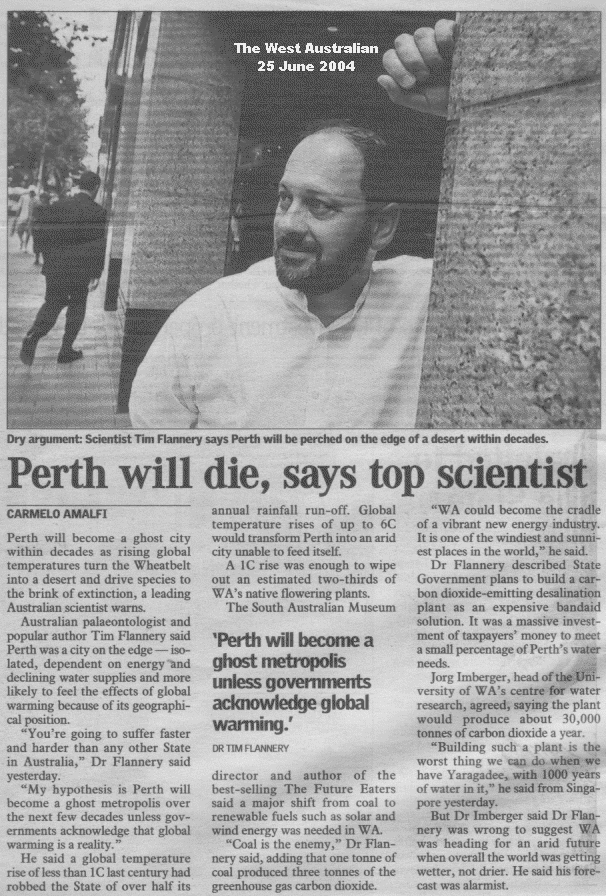
… ”I think there is a fair chance Perth will be the 21st century’s first ghost metropolis,” Article link

On Sydneys water levels:
“the ongoing drought could leave Sydney’s dams dry in just two years”
Sydney's Dam Levels


Environmental researcher Tim Flannery has warned that Brisbane and Adelaide - home to a combined total of three million people - could run out of water by year’s end.
Brisbane's dams are at 78% after one of their wettest Autumns and starts to winter in decades.
Brisbane's Dam Levels


Adelaide's Dam levels


Two of the reservoirs serving the Adelaide metropolitan area are full, after good spring rains this week.
....The Hope Valley and Warren reservoirs are both full, while the Barossa, Mount Bold and Millbrook storage levels are all above 90 per cent.
As of 10 October 2009 the dam levels were as follows:
Adelaide dam locations, storage cap.(ML) and % level
Adelaide Catchment, 195,647, 90.0%
Mt Bold, 45,874, 99.0%
South Para, 44,872, 90.0%
Myponga, 26,917, 81.0%
Little Para, 20,770, 66.0%
Kangaroo Creek, 19,009, 98.0%
Millbrook, 16,482, 93.0%
Happy Valley, 12,165, 96.0%
Warren, 5,022, 96.0%
Barossa, 4,495, 96.0%
The following is some alarmist quotes and the facts that challenge those opinions taken from the article Honouring Tim Flummery by Herald Sun columnist Andrew Bolt:
“As it has warmed over the past decade, the world has seen the most powerful El Nino ever recorded (1997-98), the most devastating hurricanes in 200 years (Mitch 1998, Katrina 2005), the hottest European summer on record (2003) and the first South Atlantic hurricane ever.”
Examining this set of claims:
Most powerful El Nino ever? Henry Diaz, research meteorologist at the US National Oceanic and Atmospheric Administration (NOAA), says the 1997-98 El Nino was big, but one in 1877-78 was “equal to this one”, causing a famine in India that killed eight million.
Katrina the “most devastating’” hurricane? The US National Climatic Data Centre says “other storms have had stronger sustained winds when they made landfall’’, including one in 1935. It adds: “The most deadly hurricane to strike the US made landfall in Galveston, Texas, on September 8, 1900 . . . claiming more than 8000 lives.” A century ago.
Hurricanes may in fact be weaker. Says the World Meteorological Organisation: “Reliable data from the North Atlantic since the 1940s indicate that the peak strength of the strongest hurricanes has not changed, and the mean maximum intensity of all hurricanes has decreased.”
Hottest European summer? Warns a study in Nature, “almost any such weather event might have occurred by chance”.
First recorded hurricane in the South Atlantic? Yes, but according to records going back just 50 years.
Professor Flannery also expresses ideas on possible cures for climate change:
The gas sulphur could be inserted into the earth's stratosphere to keep out the sun's rays and slow global warming, a process called global dimming.
"It would change the colour of the sky,"
"It's the last resort that we have, it's the last barrier to a climate collapse.
"We need to be ready to start doing it in perhaps five years time if we fail to achieve what we're trying to achieve." “As the last barrier to climate collapse.”
He conceded there were risks to global dimming using sulphur.
"The consequences of doing that are unknown."
Massive amounts of acid rain perhaps, Dr. Flannery? I thought he was trying to save the planet? But his alarmism doesn't stop there:
“Regardless of what happened to emissions in the future, there was already far too much greenhouse gas in the atmosphere.”
“Cutting emissions was not enough. Mankind now had to take greenhouse gases out of the air.”
Again a solution with no thought as to the true cost of what he is suggesting.
So-called "geoengineering" solutions that would remove CO2 from the air have been proposed by others, but the group is skeptical; they estimate that artificially removing 50ppm of CO2 from the atmosphere would cost at least $20 trillion, or twice the U.S. national debt of 2008.
Professor Flannery leaves no stone unturned in making sure his message is heard:
The Barrier Reef will become "functionally extinct" within decades at the current rate of global warming...
"The current burden of greenhouse gas in the atmosphere is in fact more than sufficient to cause catastrophic climate change,"
"Everything's going in the wrong direction at the moment, timelines are getting shorter, the amount of pollution in the atmosphere is growing.
"It's extremely urgent."
It is no longer socially acceptable for Australia to keep exporting coal knowing the damage it is doing.
There is very little gain in going with the herd if that results in a treaty that costs us the Great Barrier Reef and costs us most of our biodiversity in the Kakadu wetlands and so forth.
"The world will suicide if it cannot strike a strong climate change pact soon"
"Resistance is a suicidal tactic"
"This round of negotiations is likely to be our last chance as a species to deal with this problem"
"These negotiations are not going as smoothly as we would hope"
"The negotiators at the moment are a bit like penguins on the ice floe scared to be the first one into the water for fear of the seal lurking below"
Climate Talks Failure Could Be Prelude to War If climate talks between more than 100 Heads of State at the U.N. General Assembly in New York fail, it could have devastating consequences.
The good Professor literally can't open his mouth on this subject without submitting the listener to another series of unsubstantiated scares. Of Note, however, all this alarmism is good for sales and the lecture tours that support them as: The Weather Makers was recently No. 1 on the Canadian book charts. Given his proven lack of accuracy in his wild alarmist predictions maybe he should stick to staring at dinosaur bones.
Tuesday, August 25, 2009
Australian Scientists and Alarmism - Professor David Karoly
This tendancy to use alarmist language whenever climate change is discussed is not restricted to scintists and former politicians who are now activists from the U.S.A. Australia has its share too. Whilst, there are more than I mention in the se next posts these are some of the more high profile one's and some of the quotes and actions they have taken in this debate.
Professor Karoly's main tactic is to make declarations about certainties to do with climate change. As if by declaring them the way he does this then makes them fact not just his opinion. He is completely dismissive that there should even be a position contrary to his and uses derogatory language to describe anyone who does. He also has a tendancy to then list off wide ranging consequences of not conforming to his way of thinking and rarely in the public forum discusses any of the science behind his claims. Examples include:
"We are in an extremely precarious and urgent situation that compels immediate action"
"There is much more evidence that the rate of climate change is at the upper end of past projections and that some impacts are worse than predicted.”
“I do not know the reason for this increase in media coverage of so-called "global warming sceptics", where a common trend is to select a small amount of information to give credit to a misleading conclusion.”
The impacts are happening more dramatically and earlier than most scientists expected. The only way that I could see the climate system in 50 years time or 100years time being cooler than at present is if the earth got hit by an asteroid and basically human civilization was destroyed.
So the only solution to Climate change according to Professor Karoly is get rid of all the Human's.
This is a theme shared by many in the alarmist side of the debate. "Human's are bad", their number must be reduced severely or completely if the globe is to survive.

• Women could be forced to abort their pregnancies, whether they wanted to or not;
• The population at large could be sterilized by infertility drugs intentionally put into the nation's drinking water or in food;
• Single mothers and teen mothers should have their babies seized from them against their will and given away to other couples to raise;
• People who "contribute to social deterioration" (i.e. undesirables) "can be required by law to exercise reproductive responsibility" -- in other words, be compelled to have abortions or be sterilized.
• A transnational "Planetary Regime" should assume control of the global economy and also dictate the most intimate details of Americans' lives -- using an armed international police force.
Now thanks to President Obama this man (Holdren) is in charge of the science and climate change debate in the U.S.A.
Returning to Professor Karoly. During the debate after the telecast of “The Great Global Warming Swindle” on ABC TV (Australia) in 2007 Professor Karoly gave these two quoteable quotes:
“CO2 causes global warming!”
“CO2 levels are at their highest in a million years!”

Professor Karoly's main tactic is to make declarations about certainties to do with climate change. As if by declaring them the way he does this then makes them fact not just his opinion. He is completely dismissive that there should even be a position contrary to his and uses derogatory language to describe anyone who does. He also has a tendancy to then list off wide ranging consequences of not conforming to his way of thinking and rarely in the public forum discusses any of the science behind his claims. Examples include:
"We are in an extremely precarious and urgent situation that compels immediate action"
"There is much more evidence that the rate of climate change is at the upper end of past projections and that some impacts are worse than predicted.”
“I do not know the reason for this increase in media coverage of so-called "global warming sceptics", where a common trend is to select a small amount of information to give credit to a misleading conclusion.”
The impacts are happening more dramatically and earlier than most scientists expected. The only way that I could see the climate system in 50 years time or 100years time being cooler than at present is if the earth got hit by an asteroid and basically human civilization was destroyed.
So the only solution to Climate change according to Professor Karoly is get rid of all the Human's.
This is a theme shared by many in the alarmist side of the debate. "Human's are bad", their number must be reduced severely or completely if the globe is to survive.


• Women could be forced to abort their pregnancies, whether they wanted to or not;
• The population at large could be sterilized by infertility drugs intentionally put into the nation's drinking water or in food;
• Single mothers and teen mothers should have their babies seized from them against their will and given away to other couples to raise;
• People who "contribute to social deterioration" (i.e. undesirables) "can be required by law to exercise reproductive responsibility" -- in other words, be compelled to have abortions or be sterilized.
• A transnational "Planetary Regime" should assume control of the global economy and also dictate the most intimate details of Americans' lives -- using an armed international police force.
Now thanks to President Obama this man (Holdren) is in charge of the science and climate change debate in the U.S.A.
Returning to Professor Karoly. During the debate after the telecast of “The Great Global Warming Swindle” on ABC TV (Australia) in 2007 Professor Karoly gave these two quoteable quotes:
“CO2 causes global warming!”
“CO2 levels are at their highest in a million years!”
Subscribe to:
Posts (Atom)